Add GIZMOCHINA on Google:
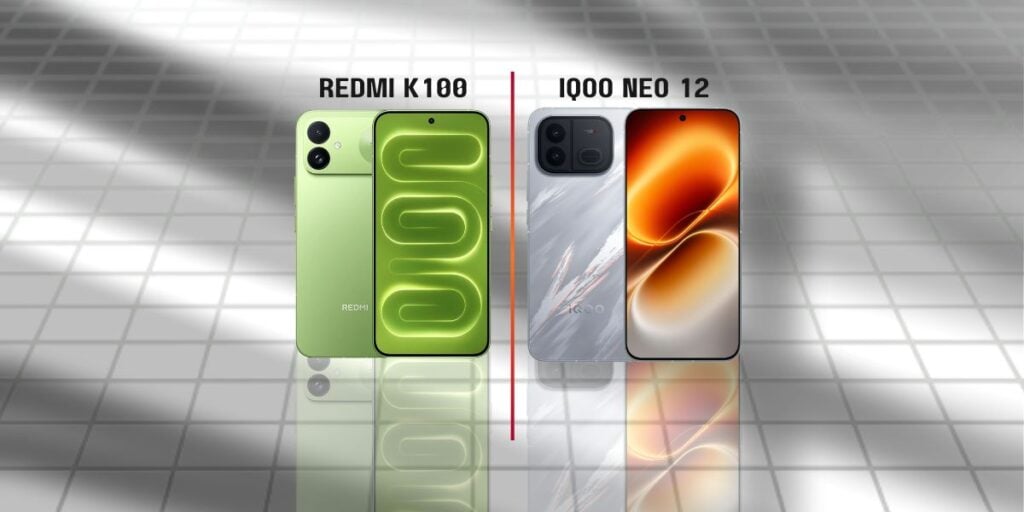
Redmi launched the Redmi K100 in China on October 26, and iQOO followed a day later with the iQOO Neo 12. Both phones have 6.83-inch displays, 3nm processors, dedicated gaming chips, 100W wired charging, and batteries with at least 9,000mAh of capacity.
Now that both are official, we can compare their hardware, gaming features, cameras, and prices to see where each phone has an advantage.
We haven’t tested either phone—reviews coming soon—so the performance figures, battery claims, and brightness numbers below come from Redmi and iQOO themselves. Both companies use their own testing methods, which means their results aren’t necessarily directly comparable.
1. Design and build
The iQOO Neo 12 and Redmi K100 are similar in size, but the Redmi is slightly wider. It measures 162.91 x 77.93mm, compared with 163.42 x 75.89mm for the iQOO.
The weight difference is more noticeable. The iQOO Neo 12 measures 8.50mm thick in Shadow Black and Frostblade Blue, while the Contender version is 8.67mm thick. Their weights range from 225g to 229g, depending on the color. The Redmi K100 measures 8.65mm thick and weighs 234.5g, around 5 to 10g heavier than the iQOO.
Both phones have flat displays and metal frames, with fiberglass backs on at least some versions. Redmi says the K100 uses a 6-series aluminum frame, while Corning Gorilla Glass 7i protects the screen and camera lenses. The iQOO Neo 12’s Contender color has a rear finish that shifts between red and gold against a silver-white background as you tilt the phone.
The Redmi K100 comes in Firefly Green, Snow Rock White, and black. The iQOO Neo 12 is available in Contender, Shadow Black, and Frostblade Blue.
Both phones carry IP68 and IP69 ratings for dust and water resistance, although Redmi offers additional IP66 and IP69K ratings too. The iQOO Neo 12 also has a built-in cooling fan, and iQOO says the fan assembly has been tested to IPX8 and IPX9 standards. It adds a double dust mesh and says the fan is built for long-term use.
The two devices also have a stereo speaker setup, but neither has a 3.5mm headphone jack. The iQOO Neo 12 also doesn’t support analog USB-C headphones, so you’ll need a digital USB-C headset or wireless earbuds.
2. Display
The iQOO Neo 12 has a sharper display and a higher refresh rate. Its 6.83-inch AMOLED panel has a resolution of 3200 x 1440, giving it a pixel density of 514 PPI. It also supports a refresh rate of up to 185Hz and displays 1.07 billion colors across the P3 gamut.
iQOO claims a full-screen peak brightness of 2,200 nits. There’s also a manual brightness mode that reaches 1,000 nits in the phone’s professional setting.
The Redmi K100 uses a 6.83-inch AMOLED display with a resolution of 2772 x 1280 and a maximum refresh rate of 165Hz. It has roughly 3.5 million pixels, compared with about 4.6 million on the iQOO, giving the Redmi around 30% fewer pixels. Its refresh rate is also about 11% lower.
The K100 also has 12-bit color support, which allows the display to show up to 68.7 billion colors, along with P3 gamut coverage. The screen can drop to 1 nit in low-light conditions and has a claimed peak brightness of 3,500 nits. It also supports HDR10+, HDR Vivid, and Dolby Vision, while the Neo 12 has HDR support without specifying the formats.
Both phones include several eye-care features. The Redmi K100 has TÜV Rheinland certifications for low blue light, rhythm friendliness, and flicker, along with full-brightness DC dimming and circularly polarized light 2.0. The iQOO Neo 12 also supports circularly polarized light 2.0 and carries TÜV Rheinland eye-protection certifications. It additionally has a 1-nit sleep screen.
3. Performance and gaming chips
The iQOO Neo 12 runs on Qualcomm’s Snapdragon 8 Elite Gen 5, a 3nm processor with two cores clocked at up to 4.6GHz and six cores running at up to 3.62GHz. Graphics are handled by the Adreno 840 GPU.
The Redmi K100 uses the Snapdragon 8 Elite, also built on a 3nm process, with a maximum clock speed of 4.32GHz. Redmi claims the processor delivers 45% better CPU performance, 40% better graphics performance, and 40% lower power consumption than its predecessor.
The iQOO has the newer processor, but both phones pair their main chips with LPDDR5X Ultra memory and UFS 4.1 storage. Buyers can choose between 12GB and 16GB of RAM, although the available storage configurations differ.
The dedicated gaming chips create another gap between the two phones. The iQOO Neo 12 uses the company’s Q3 chip, which iQOO says delivers 60% better performance, 40% better efficiency, 50% more cache, and four times the AI capability compared with the previous Q2.
The Q3 can handle ray tracing, super resolution, and frame interpolation simultaneously. iQOO says this allows supported games to run at 2K resolution and 185fps. The company also claims a 48% improvement in frame stability in one demanding 3D game. In Call of Duty: Mobile, it reports an average of 185fps during a one-hour test.
Redmi takes a different approach with its D2 gaming chip, which is built on a 12nm process. The chip handles super resolution, frame interpolation, and super HDR together, with output resolution reaching 1.5K to match the K100’s display.
According to Redmi, the D2 system reduced average power consumption by 22% and maximum temperature by 3.9°C in a popular MOBA game running at 144fps. The K100 is also the first standard Redmi K-series phone to include a dedicated gaming chip, as we noted in our Redmi K100 series teaser coverage.
The number of supported games also differs. iQOO says more than 50 games can run natively at 185fps on the Neo 12. As for K100, Redmi claims more than 40 games support 165fps gaming, while over 100 games can reach the same frame rate through frame interpolation. Some of Redmi’s native 165fps titles still need game updates, which the company expects to arrive by late November.
4. Cooling
The iQOO Neo 12 combines an active cooling fan with a 3D vapor chamber. The fan measures 17 x 17mm, has low-noise, intelligent, and high-speed modes, and moves up to 9,770 cm³ of air per minute.
iQOO also claims the vapor chamber improves heat dissipation by 15% compared with the Neo 11. Conductive fins in the airflow channels are said to increase thermal conductivity by another 15%.
The Redmi K100 doesn’t have a fan. Instead, it uses a passive cooling system called a circulating cold pump, with more than 12,000 mm² of graphite and over 31,000 mm² of total heat-spreading material. Redmi says the cooling area is 25% larger than on the previous generation and claims the phone remains cool to the touch during extended gaming sessions.
An active fan can help a phone maintain high performance during long gaming sessions, but we would need to test both devices to see how much difference their cooling systems make in practice. The fan also introduces an opening in the iQOO’s body, making its dust and water protection more complicated. That’s why the company’s water-resistance claims for the fan assembly are worth noting.
5. Controls and audio
The iQOO Neo 12 supports an instantaneous touch sampling rate of up to 5,000Hz and a multi-finger sampling rate of 500Hz. Both figures apply to supported games. Its gyroscope also samples at up to 500Hz.
The phone uses the same touch chip as the iQOO 16 and includes the company’s Q-flex control technology. Other gaming features include 4D vibration and KPL certification.
The Redmi K100 reaches an instantaneous touch sampling rate of 3,500Hz in Game Toolbox, along with 480Hz multi-finger touch sampling and a 480Hz gyroscope rate. It uses an 0815 X-axis linear motor for haptic feedback.
Audio is one area where the Redmi has more to offer on paper. Its symmetrical dual speakers are tuned by Bose, and the phone has three microphones for in-game voice chat. A dedicated Bose game sound mode increases the volume of footsteps to help players hear opponents. The K100 also supports Dolby Atmos and Hi-Res audio.
The iQOO Neo 12 has dual speakers with gaming-oriented tuning, although iQOO doesn’t list a third-party audio partner. Both phones support Bluetooth 5.4 and LHDC 5.0. The iQOO also supports LDAC, aptX Adaptive, and aptX Lossless, while the Redmi lists LDAC, LC3, and Auracast.
6. Battery and charging
The Redmi K100 has the larger battery, with a typical capacity of 10,000mAh and a rated capacity of 9,800mAh. The iQOO Neo 12 has a typical 9,000mAh battery and a rated capacity of 8,820mAh. That gives the Redmi roughly 11% more battery capacity.
Redmi uses a silicon-carbon anode with 28% silicon content and an energy density of 957Wh/L. The company claims the battery retains at least 80% of its capacity after 1,600 charge cycles.
The iQOO Neo 12 uses a fifth-generation silicon anode with 33% more silicon than the Neo 11’s battery. iQOO says its battery also retains at least 80% capacity after 1,150 cycles. These figures come from separate company tests, so they don’t establish which battery will last longer in everyday use.
iQOO claims the Neo 12 can deliver 29.9 hours of short-video playback or around 10 hours of gaming at 185fps on a single charge. Redmi describes the K100 as its longest-lasting phone, claiming 2.43 days of use based on its own battery benchmark. Independent testing will be needed to see how these claims translate to real-world battery life.
Both phones support 100W wired charging. The Redmi K100 also supports 100W PPS charging and 27W wired reverse charging. The iQOO Neo 12 supports reverse charging, although iQOO doesn’t specify its maximum output. Its 100W charging uses the company’s VFCP standard, and it also supports 55W PPS, 44W UFCS, and 18W PD.
Neither phone offers wireless charging. Both include a pass-through charging feature that lets power go directly to the phone’s components instead of repeatedly charging the battery while you play. iQOO calls this direct-drive power supply, while Redmi uses the name smart charging.
7. Cameras
Neither phone puts much emphasis on camera hardware, and their rear camera setups are similar.
The iQOO Neo 12 has a 50MP Sony IMX921 main camera with a 1/1.56-inch sensor, an f/1.88 aperture, and optical image stabilization. It also has an 8MP ultra-wide camera with an f/2.2 aperture and a 16MP front camera.
The Redmi K100 uses a 50MP Light Hunter 800 main sensor measuring 1/1.55 inches. Its lens has a wider f/1.68 aperture, and the camera supports three-axis optical image stabilization with a claimed dynamic range of 13.2EV. The ultra-wide camera also has an 8MP sensor and an f/2.2 aperture, while the front camera has a higher 20MP resolution.
The Redmi’s wider main camera aperture should let in more light than the iQOO’s lens, at least on paper. It also has the higher-resolution selfie camera. Both phones support 8K video recording with the rear camera and offer 20x digital zoom.
There are a few differences in their additional camera features. The Redmi K100 supports 4K recording at 60fps and slow-motion video at up to 960fps. The iQOO Neo 12 includes portrait modes at 23mm, 35mm, and 50mm, along with film-style filters and a macro mode.
Neither phone has a telephoto camera, so dedicated optical zoom isn’t part of the package. Camera performance will depend on more than the hardware specifications, but gaming and battery life are clearly bigger priorities for both devices.
8. Software and extras
The iQOO Neo 12 runs OriginOS 7 based on Android 17. iQOO promises six years of smooth performance and includes several additional features, such as an AI assistant mode, a sticker maker, and a PC game emulator. The emulator works with iQOO’s G1 gamepad, which is sold separately.
The Redmi K100 ships with HyperOS 4 and offers features like cross-device connectivity for moving files between the phone and a Windows or Mac computer. Both phones have a 3D ultrasonic fingerprint reader.
As for connectivity, both support Wi-Fi 7, dual nano SIMs, 5G, NFC, and infrared. Redmi includes two Surge T1+ signal chips and seven antennas, while iQOO uses two Wi-Fi enhancement chips and claims a connection range of up to 250 meters under ideal conditions.
9. Price and availability
The iQOO Neo 12 starts at 4,399 yuan for the 12GB+256GB model. The other configurations are priced at 4,799 yuan for 16GB+256GB, 5,099 yuan for 12GB+512GB, 5,499 yuan for 16GB+512GB, and 6,499 yuan for 16GB+1TB.
The Redmi K100 comes in three configurations: 12GB+256GB, 12GB+512GB, and 16GB+512GB. Their launch prices are 2,549.15 yuan, 2,999 yuan, and 3,399 yuan, respectively. These prices include a Double 11 offer and national subsidies, and sales are scheduled to begin on October 31 at 10 AM.
The two phones’ starting prices aren’t directly comparable because the Redmi’s launch price includes discounts and subsidies. The gap will be smaller for buyers who don’t qualify for the subsidy. For context, the Redmi K100 Pro and K100 Pro Max launched in August at higher prices.
Neither phone has a confirmed global launch yet. The Redmi K100 Pro and K100 Pro Max reached international markets as the Poco F9 Pro and Poco F9 Ultra on September 1, so the standard K100 could follow a similar route. That’s still unconfirmed, however.
10. Specs at a glance
| Specification | iQOO Neo 12 | Redmi K100 |
| Chip | Snapdragon 8 Elite Gen 5 (4.6GHz) | Snapdragon 8 Elite (4.32GHz) |
| Gaming chip | iQOO Q3 | Redmi D2 (12nm) |
| Cooling | Active fan + 3D vapor chamber | Passive cold pump + graphite |
| Display | 6.83-inch AMOLED, 3200 x 1440, 185Hz | 6.83-inch AMOLED, 2772 x 1280, 165Hz |
| Peak brightness (claimed) | 2,200 nits full-screen | 3,500 nits |
| Touch sampling | 5,000Hz / 500Hz multi-finger | 3,500Hz / 480Hz multi-finger |
| Battery | 9,000mAh (8,820mAh rated) | 10,000mAh (9,800mAh rated) |
| Charging | 100W wired | 100W wired, 27W reverse |
| Main camera | 50MP Sony IMX921, f/1.88, OIS | 50MP Light Hunter 800, f/1.68, OIS |
| Ultra-wide camera | 8MP, f/2.2 | 8MP, f/2.2 |
| Front camera | 16MP, f/2.45 | 20MP, f/2.2 |
| RAM | 12GB / 16GB | 12GB / 16GB |
| Storage | 256GB / 512GB / 1TB | 256GB / 512GB |
| Water resistance | IP68 / IP69 | IP66 / IP68 / IP69 / IP69K |
| Size and weight | 163.42 x 75.89 x 8.50–8.67mm, 225–229g | 162.91 x 77.93 x 8.65mm, 234.5g |
| Software | OriginOS 7 (Android 17) | HyperOS 4 |
| Starting price | 4,399 yuan | 2,549.15 yuan (with offers) |
11. Which one fits you?
The iQOO Neo 12 makes more sense if you want the newer Snapdragon chip, active cooling, and a higher refresh rate. Its 3200 x 1440 display is sharper, the touch sampling rate is higher, and it supports gaming at up to 185fps in compatible titles. It also has more storage options, with a 1TB version available.
The Redmi K100 has a larger battery, wired reverse charging, Bose-tuned speakers, a higher claimed peak brightness, and support for Dolby Vision. Its main camera also has a wider aperture, and its starting price is much lower with the launch offers and subsidies. In exchange, you get an older processor, no active cooling fan, and a display with lower resolution and refresh rate.
For daily updates, please visit our News Section.
Stay ahead in tech! Join our Telegram community and sign up for our daily newsletter of top stories.