
Add GIZMOCHINA as Preferred Source on Google
While the Snapdragon 8 Gen 3 is almost three years old, it has gained significant popularity in recent months, and all of us are aware of the reason: the rising cost of memory and RAM, and the difficulty of securing chip production. MediaTek isn’t immune to these challenges either, but its Dimensity 8400 has fast become a strong alternative for high-end devices.
Both Snapdragon 8 Gen 3 and Dimensity 8400 deliver excellent performance and power efficiency, but there are areas where one is ahead of the other. In this post, I’ll break down the benchmark scores and key differences to help you figure out the best choice for your needs.
[Note: The Dimensity 8400 Max and Dimensity 8400 Ultra simply represent brand-specific software optimizations. They share identical hardware as the Dimensity 8400.]Here’s the spec sheet to begin with:
| Snapdragon 8 Gen 3 | Dimensity 8400 | |
|---|---|---|
| Announced | October 2023 | December 2024 |
| Process node | 4nm (TSMC) | 4nm (TSMC) |
| CPU | 1 x 3.3 GHz (Cortex-X4) 3 x 3.15 GHz (Cortex-A720) 2 x 2.96 GHz (Cortex-A720) 2 x 2.27 GHz (Cortex-A520) | 1 x 3.25 GHz (Cortex-A725) 3 x 3 GHz (Cortex-A725) 4 x 2.1 GHz (Cortex-A725) |
| GPU | Adreno 750 ray tracing support Snapdragon Elite Gaming features | Mali-G720 MC7 ray tracing support MediaTek HyperEngine Adaptive Gaming Technology 3.0 |
| NPU | Qualcomm Hexagon NPU | MediaTek NPU 880 |
| Memory | LPDDR5x, up to 4.8 GHz | LPDDR5x, up to 4.2 GHz |
| Storage | UFS 4.0 | UFS 4 + MCQ |
| Camera | Qualcomm Spectra triple AI ISP (18-bit) up to 200MP single camera up to 108MP single camera with zero shutter lag up to 36MP triple cameras with zero shutter lag real-time semantic segmentation (up to 12 layers) up to 8K/30fps or 4K/120fps video recording | MediaTek Imagiq 1080 ISP up to 320MP single camera up to 32MP triple cameras at 30fps semantic segmentation support up to 4K/60fps video recording |
| Connectivity | Snapdragon X75 5G modem download speed: up to 10 Gbps upload speed: up to 3.5 Gbps Wi-Fi 7 (peak speed: 5.8 Gbps) Bluetooth 5.4 | MediaTek 5G modem download speed: up to 5.17 Gbps Wi-Fi 6E Bluetooth 5.4 |
Snapdragon 8 Gen 3 vs Dimensity 8400: Benchmark numbers
Note: The benchmark tests were performed on the iQOO 12 (powered by the Snapdragon 8 Gen 3) and the iQOO Z10 Turbo (powered by the Dimensity 8400).
Geekbench score
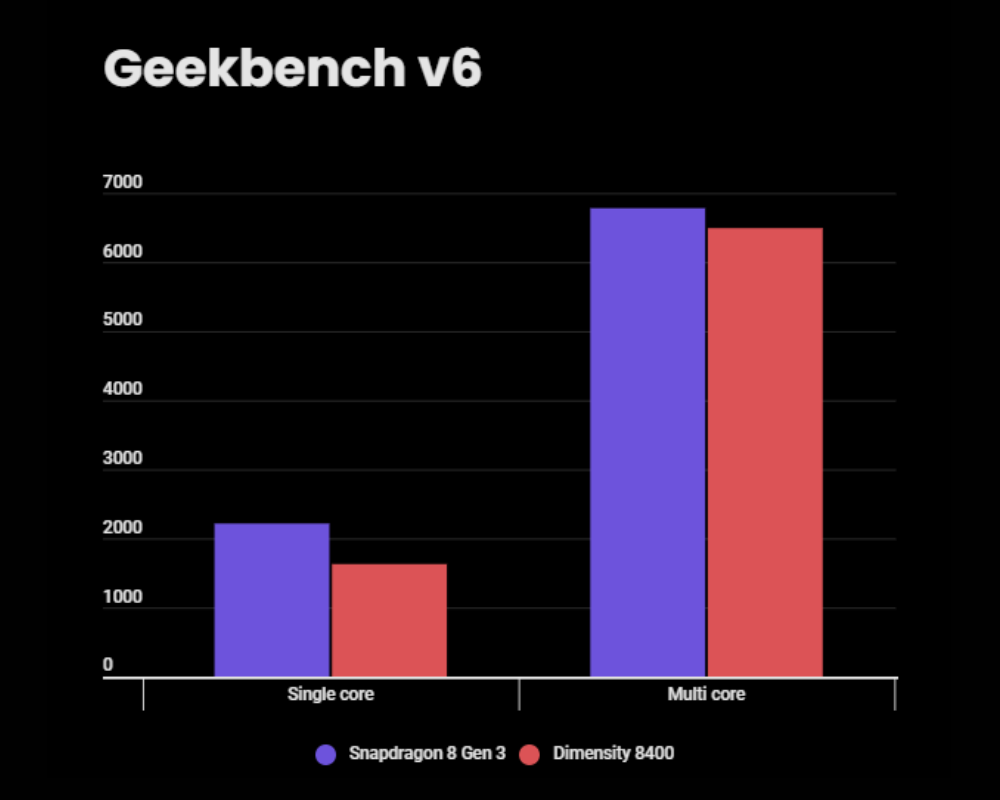
On Geekbench 6, the Snapdragon 8 Gen 3 posts a strong lead in the single-core performance, scoring 36% higher than the Dimensity 8400. That’s because of the powerful Cortex-X4 prime core.
Multi-core scores don’t have a significant difference, but the Snapdragon chip is still on the higher side.
| Snapdragon 8 Gen 3 | Dimensity 8400 | |
| Single core | 2216 | 1629 |
| Multi core | 6781 | 6492 |
AnTuTu score
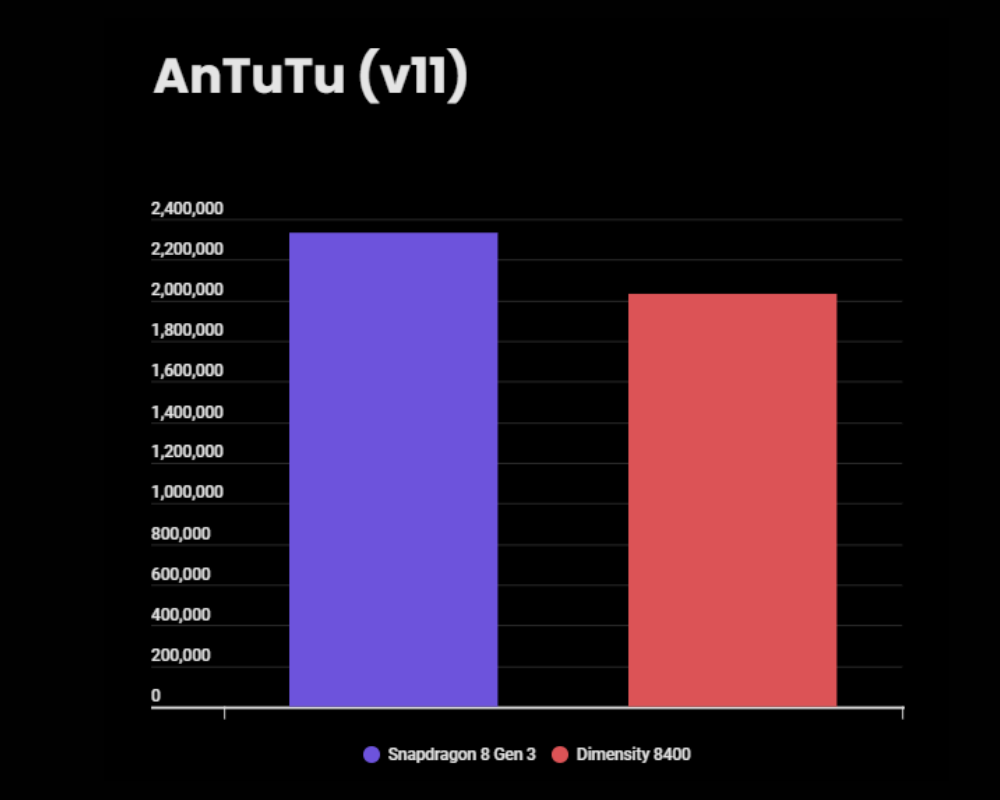
On AnTuTu v11, the iQOO 12, powered by the Snapdragon 8 Gen 3 SoC, achieves a total score of over 2.3 million, while the Dimensity 8400-powered iQOO Z10 Turbo posts a total score of just above 2 million. That’s a solid 14% boost for the Snapdragon chip.
But what matters more is the breakdown of the AnTuTu score, which provides a clearer picture.
| Snapdragon 8 Gen 3 | Dimensity 8400 | |
| AnTuTu score | 2,332,791 | 2,031,886 |
| CPU | 643,123 | 624,883 |
| GPU | 818,651 | 645,958 |
| Memory | 348,240 | 295,315 |
| UX | 522,777 | 465,730 |
The Snapdragon 8 Gen 3 leads the CPU chart, but the difference is thin. The GPU score, however, makes a significant impact here. The Snapdragon chip achieves a massive 26% lead over the Dimensity 8400.
Memory and UX performance also favor the Snapdragon chip.
From benchmark results, it’s clear that the Snapdragon 8 Gen 3 has a more powerful CPU and GPU than the Dimensity 8400. However, benchmarks leave some important aspects untouched, such as connectivity and the camera. We’ve included the important differences in the following section.
Shoppers deciding between generations can weigh this one against newer options in our Snapdragon chipset rankings.
Snapdragon 8 Gen 3 vs Dimensity 8400: Key differences that matter
Performance
Both the Snapdragon 8 Gen 3 and the Dimensity 8400 use ARM-designed CPUs but have completely different core configurations. The Snapdragon chip features a ‘1+3+2+2’ core structure, while the Dimensity chip uses a ‘1+3+4’ structure.
| Snapdragon 8 Gen 3 | Dimensity 8400 | |
| Prime core | 1 x Cortex-X4 at 3.3 GHz | 1 x Cortex-A725 at 3.25 GHz |
| Performance core | 3 x Cortex-A720 at 3.15 GHz 2 x Cortex-A720 at 2.96 GHz | 3 x Cortex-A725 at 3 GHz |
| Efficiency core | 2 x Cortex-A520 at 2.27 GHz | 4 x Cortex-A725 at 2.1 GHz |
The Dimensity 8400 has an all-big-core CPU design, featuring superior mid-level and low-level cores. However, the powerful Cortex-X4 core and higher clock speeds on the Snapdragon chip have a greater impact.
For graphics-heavy tasks, the Snapdragon 8 Gen 3 has an Adreno 750 GPU, featuring more shading units and higher FLOPS than the Mali-G720 GPU on the Dimensity 8400. When it comes to gaming, the Snapdragon chip delivers higher, more consistent performance without noticeable lag.
Both processors also have integrated NPUs for on-device AI intelligence. The Hexagon NPU on the Snapdragon 8 Gen 3 supports generative AI models with up to 10 billion parameters. It also powers the image signal processor (ISP) to improve semantic segmentation, night shots, and photo expansion.
The Dimensity 8400 features a MediaTek NPU 880, optimized to support both Generative AI and Agentic AI, allowing the device to run complex, multi-step on-device AI agents. The AI engine is tightly coupled with the ISP, enabling real-time AI image and video enhancements.
Camera
The Snapdragon 8 Gen 3 utilizes the Spectra Cognitive ISP with three 18-bit pipelines to handle simultaneous data streams. It features real-time semantic segmentation up to 12 layers and integrates advanced AI features, including Video Object Eraser, Photo Expansion, Night Vision Video, and Generative AI Editing.
The Dimensity 8400, on the other hand, features a MediaTek Imagiq 1080 ISP, optimized to deliver high dynamic range, reduce noise in low-light environments, and ensure zero shutter lag across multi-camera configurations.
The Dimensity 8400 supports up to 4K video recording, while the Snapdragon 8 Gen 3 goes further up to 8K. The latter also supports Dolby HDR photo technology and Vlogger’s View.
Connectivity
The Snapdragon 8 Gen 3 utilizes an advanced Snapdragon X75 5G modem, offering up to 10 Gbps download speed and up to 3.5 Gbps of upload speed. In contrast, the Dimensity 8400 offers a lower peak speed of 5.17 Gbps.
While both chips support sub-6GHz connectivity, the Snapdragon chip also supports mmWave, which operates on ultra-high frequency bands. The Snapdragon chip also benefits from the newer Wi-Fi 7 standard, while the Dimensity 8400 is limited to Wi-Fi 6E.
Snapdragon 8 Gen 3 vs Dimensity 8400: Which is better?
The Snapdragon 8 Gen 3 is the clear winner here. It holds a distinct edge in raw performance, thanks to its higher clock speeds, powerful prime core, and superior Adreno 750 GPU. The chipset delivers more consistent, lag-free gaming and smoother graphics-heavy performance compared to the Dimensity 8400. It also offers modern connectivity features and higher peak speeds.
However, if you aren’t a gaming-heavy user, the Dimensity 8400 could be a better choice. It delivers smooth everyday performance, excellent power efficiency, and lag-free gaming on moderate settings. The Dimensity chip also stands out for agentic AI support.

Comments